
In recent years, 3D printing has revolutionized manufacturing, design, and prototyping processes across various industries. Among the many advancements in additive manufacturing, the use of composite materials in 3D printing stands out as a significant development. Composite materials, known for their enhanced strength, lightweight properties, and versatility, are increasingly being integrated into 3D printing to create high-performance parts with complex geometries. This article provides an in-depth introduction to 3D printing with composite materials, exploring what they are, how they are used, and the benefits they offer.
What Are Composite Materials?
Composite materials are engineered substances made by combining two or more constituent materials with different physical or chemical properties. The goal is to produce a new material that exhibits superior characteristics compared to the individual components. Typically, composites consist of a matrix and reinforcement.
- Matrix: The continuous phase that holds the composite together, providing shape and transferring loads. Common matrices include polymers, metals, or ceramics.
- Reinforcement: The dispersed phase that provides strength and stiffness. Common reinforcements include fibers such as carbon, glass, or aramid fibers.
When used in 3D printing, composite materials often combine base polymers with reinforcing fibers or particles, resulting in parts that are stronger, more durable, and lighter than traditional materials.
Types of Composite Materials Used in 3D Printing
Fiber-Reinforced Composites
These include filaments or powders embedded with fibers like carbon fiber, glass fiber, or Kevlar. Carbon fiber-reinforced composites are particularly popular due to their high strength-to-weight ratio.
Particle-Reinforced Composites
These contain particles such as metal powders, ceramics, or other fillers dispersed within a polymer matrix to enhance specific properties like thermal stability or wear resistance.
Hybrid Composites
Combining multiple reinforcement types or matrices to achieve tailored properties for specific applications.
Methods of 3D Printing with Composite Materials
Several additive manufacturing techniques can be used to print composite materials, each suited to different types of composites and applications:
- Fused Deposition Modeling (FDM): This method uses composite filament spools that contain fibers embedded in a thermoplastic matrix. The filament is extruded layer-by-layer to build the part. FDM with composite filaments is popular due to its accessibility and ease of use.
- Selective Laser Sintering (SLS): Utilizes laser energy to sinter powder-based composites, often with ceramic or metal reinforcements, to produce high-strength parts.
- PolyJet and MultiJet Printing: These techniques can print composite-like materials with multiple resins and embedded fibers or particles, allowing for complex geometries and multi-material properties.
- Direct Ink Writing (DIW): Involves extruding viscous composite inks that can contain fibers or particles, suitable for printing large, complex structures
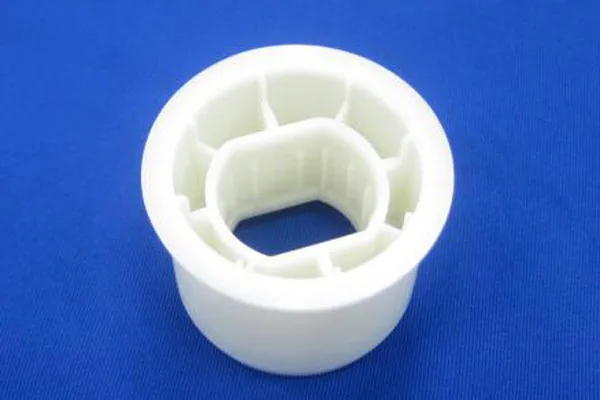
SLA part
Benefits of 3D Printing with Composite Materials
Enhanced Mechanical Properties: Composites can significantly improve strength, stiffness, and impact resistance, making parts suitable for demanding applications.
Lightweight Components: By incorporating reinforcements like carbon fiber, parts can maintain high strength while reducing weight, which is critical in aerospace, automotive, and sports industries.
Design Flexibility: Additive manufacturing allows the creation of complex geometries that traditional manufacturing methods cannot produce, combined with the superior properties of composites.
Rapid Prototyping and Customization: 3D printing with composites enables quick development of prototypes and highly customized parts tailored to specific needs.
Reduced Material Waste: Additive processes are inherently material-efficient, minimizing waste compared to subtractive manufacturing.
Challenges and Considerations
While composite 3D printing offers numerous advantages, it also presents challenges:
- Material Compatibility: Not all composites are suitable for 3D printing, and selecting the right materials is crucial.
- Processing Parameters: Achieving optimal print quality and mechanical properties requires precise control of temperature, layer adhesion, and fiber orientation.
- Cost: High-performance composite filaments or powders can be expensive, and equipment investments may be significant.
- Post-Processing: Some composite parts may require additional finishing, curing, or surface treatment to meet specifications.
Applications of 3D Printed Composite Materials
The versatility of composite 3D printing opens doors to numerous applications, including:
Aerospace: Lightweight structural components, brackets, and housings.
Automotive: Functional prototypes, custom parts, and lightweight structural elements.
Medical: Customized implants and prosthetics with improved strength and biocompatibility.
Industrial: Tooling, jigs, fixtures, and end-use parts requiring high durability.
Sports Equipment: High-performance gear, such as bicycle frames and protective gear.
Future Outlook
As materials science and 3D printing technologies continue to evolve, the integration of composite materials in additive manufacturing is expected to expand further. Innovations in fiber-reinforced filaments, multi-material printing, and post-processing techniques will enable the production of even more complex, high-performance parts tailored to specific industry needs.
Conclusion
3D printing with composite materials represents a significant leap forward in additive manufacturing, combining the advantages of complex geometries with enhanced material properties. Whether for aerospace, automotive, medical, or industrial applications, composite 3D printing offers unparalleled design flexibility, performance, and efficiency. As technology advances and material options grow, this field promises to unlock new possibilities for innovative product development and manufacturing solutions.