
Vacuum casting remains a popular manufacturing method for businesses that need high-quality prototypes or small batches of plastic parts. It offers a practical balance of speed, detail, material flexibility, and cost—especially when injection molding would be too expensive or time-consuming.
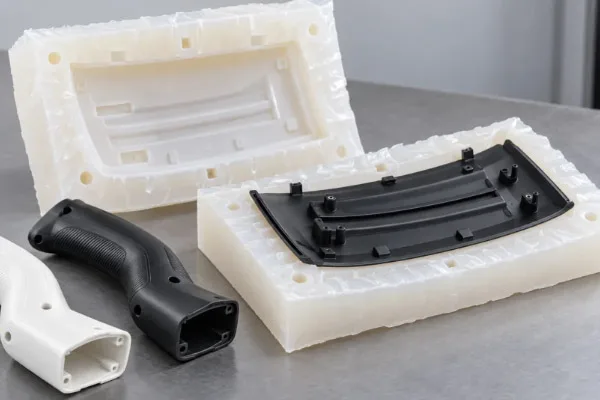
Vacuum casting parts
What Is Vacuum Casting?
Vacuum casting is a process used to make parts from liquid polyurethane resin. First, a master pattern is created, often using 3D printing or CNC machining. The pattern is used to make a flexible silicone mold.
The mold is placed in a vacuum chamber, where resin is poured into it. The vacuum helps remove trapped air, allowing the material to fill fine details and produce a clean, accurate part. Once the resin cures, the part is removed, finished, and inspected.
Because silicone molds wear out over time, vacuum casting is generally best suited to prototypes and low-volume production rather than large-scale manufacturing.
A Cost-Effective Option for Small Production Runs
One of the main reasons companies choose vacuum casting is its relatively low setup cost. Injection molding requires durable metal tooling, which can be expensive to design and manufacture. That investment makes sense for large production runs, but it may not be practical when only a small number of parts are needed.
Silicone molds are quicker and less expensive to produce. This makes vacuum casting useful for creating a handful of prototypes, producing pilot batches, or supplying limited quantities before a product moves into mass production.
Faster Than Traditional Tooling
Developing a metal injection mold can take considerable time. Vacuum casting generally involves a simpler mold-making process, so parts can often be produced sooner.
This speed helps product teams evaluate designs, test components, and gather feedback without waiting for production tooling. If a design needs to change, a new master pattern and silicone mold can often be made more easily than revising a metal tool.
Excellent Detail and Surface Quality
Vacuum casting can reproduce small features and fine surface details from the master pattern. Since the silicone mold is flexible, it can also make it easier to remove parts with complex shapes or undercuts.
The process can produce smooth, professional-looking components that are suitable for design reviews, customer demonstrations, and product photography. Depending on the master pattern and finishing process, parts can also be made with textures, gloss levels, or other surface treatments.
A Wide Range of Material Options
Vacuum casting uses polyurethane resins that can be selected to imitate different material properties. Depending on the resin, parts may be designed to resemble rigid plastics, flexible elastomers, transparent materials, or rubber-like components.
Some resins can also imitate the appearance of common production plastics, such as ABS or polypropylene. While a cast resin is not always identical to the final production material, the range of options makes it possible to test a design’s look and feel before choosing a full-scale manufacturing process.
Useful for Functional Prototypes
Vacuum-cast parts are not just for appearance. Many can be used for basic functional testing, including checking assembly fit, evaluating ergonomics, and confirming that components work together as intended.
The suitability of a part for testing depends on the resin and the demands of the application. For example, a prototype intended to withstand repeated impact or high temperatures may require a material and process specifically suited to those conditions. Vacuum casting can provide valuable early-stage feedback, but it may not replace testing with the final production material.
Consistent Results for Short Runs
Once a silicone mold is prepared, it can produce multiple parts with a similar appearance and geometry. This consistency makes vacuum casting useful when teams need more than one prototype—for example, to provide samples to stakeholders, test several assemblies, or conduct limited user trials.
The number of parts a mold can produce depends on the part’s complexity, the resin, and how carefully the mold is handled. Silicone molds eventually wear down, so the process is most appropriate for limited quantities.
Supports Design Changes and Product Development
Product development often involves repeated revisions. Vacuum casting fits well into this process because it allows teams to create realistic parts without committing immediately to expensive production tooling.
A company can use cast parts to assess a design, identify problems, and make improvements. After the design is proven, the manufacturer can decide whether to continue with low-volume casting or move to injection molding or another production method.
Vacuum Casting Compared with Other Prototyping Methods
Different prototyping methods serve different purposes. Vacuum casting is often chosen when the goal is to produce parts that look and feel like production components but the required quantity is still relatively low.
|
Method |
Setup Cost |
Typical Lead Time |
Materials |
Best Fit |
| 3D Printing | Low | Hours to days | Photopolymers, thermoplastics, resins | Early concept models and rapid iterations |
| CNC Machining | Low to medium | Days | Production-like plastics and metals | Accurate functional prototypes with simple to moderate geometry |
| Vacuum casting | Low to medium | Days | Polyurethane resins | Realistic prototypes, pilot batches, and small production runs |
| Injection molding | High | Weeks to months | Production-grade thermoplastics | High-volume manufacturing |
When Is Vacuum Casting the Right Choice?
Vacuum casting is often a good fit when:
- You need a small number of parts.
- You want realistic prototypes for review or testing.
- You need a faster, lower-cost alternative to production tooling.
- Your design includes fine details or complex shapes.
- You want to compare different material appearances or properties.
- You need samples before committing to mass production.
It may be less suitable for very large production volumes, parts exposed to demanding operating conditions, or applications that require the exact properties of a specific production-grade material. In those cases, another process may be more appropriate.
Conclusion
Vacuum casting continues to be a go-to choice because it makes high-quality, detailed parts accessible without the cost and lead time of traditional production tooling. Its combination of design flexibility, material options, and suitability for short runs makes it valuable for prototyping, product validation, and limited production.
For businesses developing a new product, vacuum casting can help bridge the gap between an early design concept and full-scale manufacturing—providing tangible parts to evaluate before making a larger investment.