
In the manufacturing landscape, the need for rapid prototyping, low-volume production, and short lead times has driven innovation in mold-making techniques. Among these innovations, Aluminum injection molding have emerged as a versatile and cost-effective solution, bridging the gap between concept development and full-scale production. By leveraging the unique properties of aluminum, manufacturers can significantly reduce tooling costs and lead times while maintaining acceptable quality and durability for various applications.
What is Aluminum Injection Molding?
Aluminum injection molding are molds made primarily from aluminum alloys, designed for plastic injection molding processes. Unlike traditional steel molds, aluminum molds are lighter, easier to machine, and more affordable, making them ideal for short runs, rapid prototyping, and low-volume manufacturing.
The Concept of “Bridge to Production”
The “bridge” concept refers to using aluminum molds as an intermediate step that enables:
- Rapid testing and validation of parts
- Early production runs with real-world conditions
- Informing final steel tooling design
- Reducing overall time-to-market
Essentially, aluminum molds provide a cost-effective and flexible platform to transition from concept to full-scale production smoothly.
Advantages of Aluminum injection molding
Rapid Lead Times
Aluminum alloys are easy to machine, allowing mold fabrication in a fraction of the time required for steel molds.
Typical lead times range from a few days to a few weeks, compared to several months for steel.
Lower Cost
Material costs are lower, and the machining process is faster.
Suitable for low to medium-volume production, reducing initial investment.
Flexibility and Design Iteration
Aluminum molds can be easily modified or reworked, facilitating design changes during development.
Supports iterative testing of different designs or material variations.
Good Thermal Conductivity
Aluminum dissipates heat efficiently, leading to faster cycle times and better process control.
Durability for Early-Stage Production
While not as long-lasting as steel, aluminum molds are durable enough for hundreds to thousands of cycles, sufficient during prototype and low-volume runs.
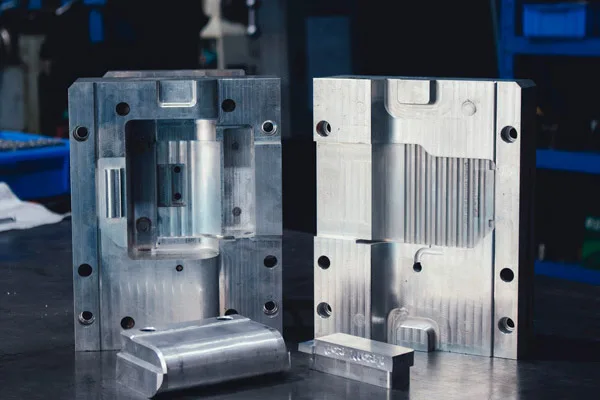
Rapid mold
Design Considerations for Aluminum Molds
While aluminum molds offer many benefits, their design must account for certain limitations to maximize performance:
1. Material Selection
Common aluminum alloys include Aluminum 7075, 5083, and 6061.
Alloys with high strength and good machinability are preferred for mold inserts.
2. Part Design and Complexity
Design should consider uniform wall thickness and draft angles to facilitate ejection and reduce wear.
Avoid extremely thin features or intricate geometries that may accelerate mold wear.
3. Cycle Time and Part Volume
Aluminum molds are best suited for short to medium cycle times and low to moderate production volumes.
Heavy-duty or high-precision parts may require steel molds.
4. Ejection System and Venting
Proper ejection mechanisms and venting are critical to prevent defects and ensure smooth operation.
5. Cooling Channels
Incorporate efficient cooling systems to optimize cycle times and part quality.
6. Surface Finish
Aluminum molds can achieve excellent surface finishes, but post-processing may be needed for aesthetic or functional requirements.
7. Durability Enhancements
Surface treatments like hard anodizing or coatings can extend mold life and resistance to wear.
Limitations of Aluminum Molds
- Reduced Wear Resistance: Less durable than steel, prone to deformation or wear after prolonged use.
- Limited Cycle Life: Generally suitable for hundreds to a few thousand cycles, making them less ideal for high-volume production.
- Thermal Expansion: Aluminum’s higher coefficient of thermal expansion can cause dimensional changes, necessitating careful design and process control.
- Less Suitable for High-Precision Parts: Tight tolerances may be challenging to maintain over time.
Industry Applications of Aluminum injection molding
Prototype Development and Testing
Rapidly producing prototype parts for fit, form, and function testing.
Validating design concepts before committing to steel tooling.
Low-Volume Production
Manufacturing initial production runs to assess market response.
Reducing time-to-market and enabling quick iterations.
Tooling for Overmolding and Insert Molding
Creating molds for overmolding processes, where multiple materials or components are combined.
Medical Devices and Consumer Products
Producing small batches of complex, high-quality parts with aesthetic requirements.
Automotive and Consumer Electronics
Manufacturing functional prototypes, small series, or custom components.
Transitioning from Aluminum to Steel Molds
A common strategy involves using aluminum molds during early development to test and validate designs. Once the product design is finalized and volume increases, manufacturers often switch to steel molds for longer cycle life, higher precision, and durability in full-scale production.
This approach minimizes risks, reduces upfront costs, and accelerates the overall product development cycle.

Aluminum rapid tooling product
Future Trends and Innovations
Hybrid Molds: Combining aluminum inserts with steel components for enhanced durability.
Additive Manufacturing of Molds: Using metal 3D printing to produce complex cooling channels and mold inserts.
Surface Treatments: Advanced coatings extend the lifespan of aluminum molds.
Smart Mold Technologies: Incorporating sensors for real-time monitoring and process optimization.
Conclusion
Aluminum injection molding serve as a vital bridge in the product development journey—offering a cost-effective, rapid, and flexible solution that accelerates innovation and reduces time-to-market. While they are not suitable for high-volume, high-precision manufacturing, their role in prototyping, low-volume production, and iterative testing is invaluable.
By carefully designing and managing aluminum molds, manufacturers can optimize their development pipelines, gain valuable insights, and seamlessly transition to full-scale steel tooling when ready for high-volume production.