
In the automotive industry, sealing systems are critical components that ensure vehicle safety, comfort, and durability. Among these, door seals play a vital role in preventing water, dust, noise, and air infiltration, thereby enhancing passenger comfort and protecting internal vehicle systems. The manufacturing of high-quality door seals demands materials and processes that deliver precise dimensions, excellent sealing performance, and long-term durability. Compression molding is a proven and time-tested process for manufacturing rubber parts. In this process, a pre-measured rubber blank is placed directly into a heated mold cavity, pressed into shape under mechanical pressure, and then cured by targeted temperature control to complete the vulcanization process. For automotive weatherstripping manufacturing, compression molding is rarely used in isolation; It is strategically integrated with extrusion to create complex corner joints, pushpin attachments and hybrid features that complete a functional seal assembly.
Understanding Compression Molding
Compression molding is one of the oldest and most widely used rubber shaping processes, characterized by a relatively straightforward yet highly effective operational sequence. This process is fundamentally different from injection molding: whereas injection molding introduces softened material under high pressure into a closed mold, compressive molding relies on mechanical forces to compress a pre-measured amount of uncured rubber compound into the desired shape within an open, heated mold cavity.
The complete process sequence involves several precisely controlled steps:
First, a pre-measured amount of uncured rubber compound—typically in the form of a preform, blank, or strip—is inserted directly into the lower half of an open, heated mold cavity. This blank may be geometrically pre-fitted to approximate the final shape, facilitating more efficient cavity filling.
Second, the upper mold half is brought down under hydraulic pressure—typically ranging from 20 to 100 tonnes depending on part size and complexity—forcing the rubber compound to flow evenly into all regions of the mold cavity.
Third, the material undergoes vulcanization: depending on the specific material formulation and the desired degree of cross-linking, the material is heated to temperatures ranging from 120°C to 220°C and held for a defined time to allow complete curing.
Fourth and finally, after vulcanization completes, the mold opens and the finished part is removed, generally followed by post-processing steps such as deburring to remove flash or coating for enhanced surface properties
The rubber vulcanization process itself is a key step in determining whether a rubber seal will perform reliably over time. This process cures rubber at approximately 140–180°C under pressure, allowing polymer chains to form a crosslinked network that transforms raw rubber from a soft, unstable material into a durable elastic structure suitable for demanding sealing applications. The conversion is thermally activated, and proper control of the rubber curing temperature and pressure is essential to achieve the final mechanical properties of the rubber, including tensile strength, compression set, and service life.
Materials for Compression Molding Automotive Door Seals
EPDM Rubber:
The Industry Standard EPDM (ethylene propylene diene monomer) is the primary material used for automotive weatherstrips and sealing systems because of its excellent weather, ozone, UV, and temperature resistance. Its molecular structure, lacking double bonds, provides superior durability against environmental degradation.
Key Properties:
- Low Compression Set: Maintains its shape and sealing ability over time with a value below 15%, ensuring long-term effectiveness – typically lasting 10-15 years in the vehicle.
- Wide Temperature Range: Performs reliably from -40°C to +125°C, making it suitable for cold winters and hot summers, including engine compartments.
- Weather Resistance: Excellent resistance to UV radiation, ozone, and outdoor weathering, making it ideal for exterior seals.
- Chemical & Abrasion Resistance: Resistant to mild acids and mechanical wear but not compatible with petroleum-based oils and fluids.
- Long life: 20 to 50 years depending on environmental exposure, with automotive applications generally supporting 10-15 years of service.
Thermoplastic Elastomers (TPE and TPV)
Thermoplastic vulcanizates (TPVs), a type of thermoplastic elastomer, are increasingly used as alternatives or supplements to EPDM in automotive sealing due to their lighter weight, recyclability, and ease of processing.
Advantages:
- Weight Reduction: About 30% lighter than the EPDM, with the ability to produce a thinner profile, which helps reduce overall vehicle weight – beneficial for electric vehicles.
- Superior Long-Term Seal: Demonstrates lower long-term compression set values, maintaining sealing performance over extended periods.
- Enhanced Heat Aging: Retains physical properties better at high temperatures, suitable for engine compartments.
- Colorability & Aesthetic Benefits: Can be easily colored, maintaining appearance over time without chalking or cracking.
- Chemical & Environmental Resistance: Better resistance to automotive chemicals and environmental factors.
- Recyclability & Sustainability: Can be reprocessed and recycled to align with eco-friendly manufacturing goals.
- Processing Efficiency: Easier and faster to produce, reducing manufacturing costs and complexity.
Silicone Rubber and Other Specialized Materials
For applications that require extreme temperature performance beyond the capabilities of EPDM or TPV, silicone rubber is used. It offers superior heat resistance and flexibility at very high or low temperatures, making it suitable for high-temperature engine seals, cooling system gaskets, and specialized applications. However, it is reserved for niche uses due to its high cost.
Other materials like neoprene (polychloroprene) provide good oil and chemical resistance, while fluorocarbon elastomers are chosen for extreme chemical exposure. These are less common in standard automotive door seals, but are used where specific chemical or environmental resistance is required.
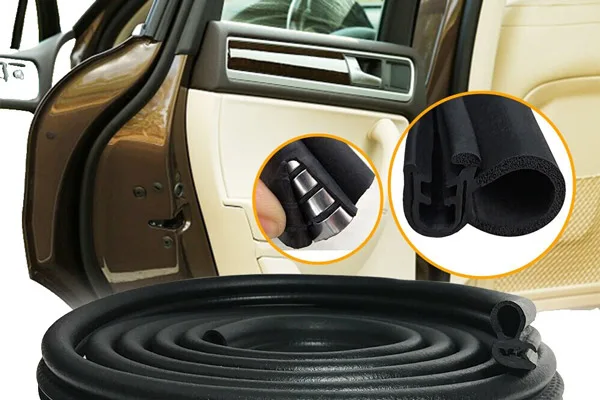
Auto door rubber seal strips
Applications of Compression Molding in Automotive Door Seals
Corner Moldings:
The main use of compression molding is to create seamless corner joints where the extruded weatherstrips turn sharp corners. The process involves inserting the strip ends into a mold, injecting uncured rubber, and forming a bonded, smooth joint that maintains sealing integrity. Advanced mold designs prevent deformation of sponge rubber regions, ensuring reliable long-term seals made from durable EPDM profiles.
Push-Pin and Attachment Features:
Compression molding integrates attachment points like molded pins or posts that snap into vehicle holes, eliminating adhesives or separate fasteners. These pushpin seals are ideal for low-adhesion surfaces, providing a secure, reusable connection. This process also allows for other integration features such as clip-on retainers, reducing assembly time and cost.
Hybrid Extrusion-Compression Seals:
Combining extrusion and compression molding, these seals feature extruded sponge sections for flexibility and molded dense rubber corners for reinforcement. Small molded inserts (stuffer plugs) strengthen stressed areas, preventing collapse. Bonding occurs during vulcanization, creating a seamless, durable seal without adhesives.
Small Components and Inserts:
Compression molding produces a variety of small components such as grommets, sealing rings, bumpers, caps and O-rings used throughout vehicle door systems. It offers accurate shape, versatile materials, and cost-effective production, and is particularly suitable for medium volumes and complex geometries.
Compression Molding vs. Alternatives
Compression vs. Extrusion
Compression Molding: Ideal for complex shapes, corners, attachment features, and small batches. Uses molds for discrete parts.
Extrusion: Produces continuous, uniform profiles like weatherstrips. Faster and cost-effective for long, simple sections Use compression for complex, multi-dimensional parts; extrusion for linear, long runs.
Compression vs. Rubber Injection Molding
Injection Molding: Fast, precise, high-volume production with complex geometries. Higher tooling costs and initial setup.
Compression Molding: Slower, suited for smaller batches, thick-walled, or high-viscosity materials. Lower tooling costs. Choose injection for high-volume, detailed parts; compression for small runs or difficult materials.
Compression vs. Transfer Molding
Transfer Molding: Intermediate process, better for complex designs and inserts. Uses channels to fill molds, with lower complexity than injection.
Compression Molding: Simpler, less precise, suited for basic shapes. Transfer molding bridges the gap for complex parts needing inserts, offering better fill quality than compression.
Quality Control and Testing
Ensuring the performance of automotive door seals produced via compression molding involves rigorous testing, including:
- Dimensional Inspection: Verifying profile accuracy and consistency.
- Leakage Tests: Checking sealing effectiveness against water and air infiltration.
- Environmental Testing: Assessing resistance to UV, ozone, temperature cycling, and chemical exposure.
- Mechanical Testing: Measuring tensile strength, elongation, and compression set to confirm durability.
Conclusion
Compression molding plays an essential, complementary role in manufacturing automotive door seals. While extrusion produces long, uniform weatherstrip profiles, compression molding enables the creation of critical features—seamless corner joints, push-pin attachments, and hybrid seals—that extrusion alone cannot achieve. By precisely controlling temperature, pressure, and curing time, the process delivers durable EPDM or lightweight TPV seals with excellent compression set, weather resistance, and service lives exceeding 10 years. Compared to injection molding, compression molding offers lower tooling costs and greater material flexibility, making it ideal for smaller volumes, complex geometries, and high-viscosity compounds. As the automotive industry shifts toward electric vehicles, lightweighting, and sustainability, compression molding remains a vital, cost-effective technology for producing reliable, high-performance door seals.