
When people talk about engineering plastics used in injection molding, Nylon and POM usually come up quite often. These two materials are both widely used in different industries such as automotive, electronics, machinery, and consumer products. Many engineers will compare Nylon and POM when deciding which plastic material is better for their parts. In many cases, the decision between these two materials depends on what the part needs to do and what kind of environment it will work in.
Nylon, which is also called Polyamide (PA), is one of the most widely used engineering plastics in the world. POM, also called Polyoxymethylene or sometimes Acetal, is another very common engineering plastic that is especially known for its good dimensional stability and low friction. Both materials have their advantages and disadvantages, and neither one is always better than the other. It really depends on the application.
In practical injection molding projects, engineers may choose Nylon when they need toughness and impact resistance, while POM may be chosen when better precision and smoother sliding behavior are required. But sometimes the choice is not that simple, because both materials have a wide range of grades and modified versions.
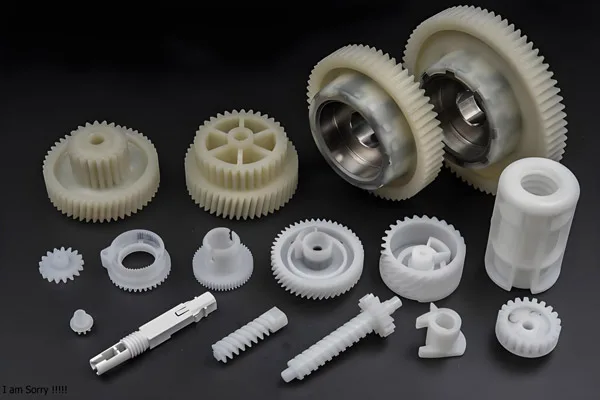
POM products-1
Nylon Materials
Nylon is a type of polymer that contains repeating amide groups in its molecular structure. It was one of the first synthetic polymers that became commercially successful, and today it is still widely used. Nylon can be used in the form of fibers, films, and engineering plastics, but in injection molding we mainly talk about the engineering plastic versions.
There are many types of Nylon materials. The most common ones used in injection molding are PA6 and PA66. These two materials are often used because they provide a good balance of strength, durability, and cost. PA6 is generally easier to process and has better impact resistance compared with PA66. PA66, on the other hand, usually offers higher stiffness and better heat resistance.
Another type of Nylon is PA12. Compared with PA6 and PA66, PA12 has much lower moisture absorption. Because of this, it tends to have better dimensional stability when parts are exposed to humid environments. Some engineers prefer PA12 for precision parts or components that are exposed to water or chemicals.
There are also other Nylon types such as PA610, PA612, and some high temperature Nylons like PA46 or PA6T. These materials are typically used in more specialized applications, especially when higher temperature resistance is required. For example, certain automotive parts located near engines may use high temperature Nylon materials.
Sometimes Nylon materials are reinforced with glass fiber. This is very common in engineering applications. Adding glass fiber can significantly improve strength, stiffness, and heat resistance. It also helps reduce shrinkage during molding. A typical example would be PA66 with 30% glass fiber reinforcement. This type of material is commonly used for structural parts in automotive or industrial equipment.
Glass fiber reinforced Nylon is used in many different applications such as fan blades, pump housings, gears, brackets, and other load-bearing components. However, when glass fiber is added, the material becomes more abrasive and may cause more wear on the injection molding machine components like screws and barrels.
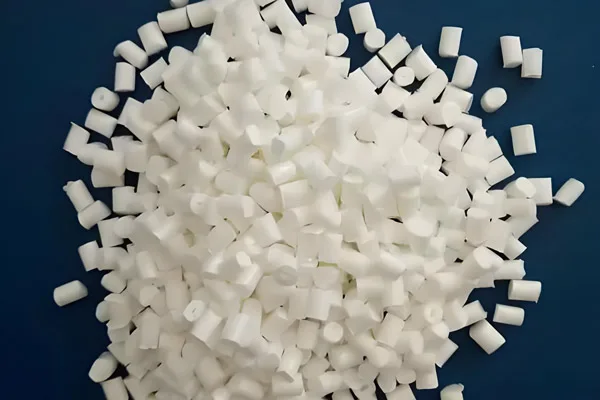
Nylon particles
Properties of Nylon
One reason Nylon is widely used is because it has a good combination of mechanical properties. Nylon typically has high tensile strength and good toughness. It also performs well in dynamic applications where parts may experience repeated loads or impacts.
Another important feature of Nylon is its wear resistance. Nylon has some self-lubricating properties, which means that it can be used in moving parts such as gears, bearings, and rollers. However, the friction coefficient of Nylon is not always the lowest among engineering plastics. In some sliding applications, other materials like POM may perform better.
Nylon also has relatively good heat resistance compared with many common plastics. Certain Nylon grades can work at temperatures around 100°C or even higher, depending on the formulation and reinforcement. This makes Nylon useful in automotive components or other applications where moderate heat exposure occurs.
However, Nylon also has some limitations. One of the most well-known issues is moisture absorption. Nylon absorbs water from the environment, and this can affect its mechanical properties and dimensions. For example, when Nylon absorbs moisture, it usually becomes slightly softer and more flexible. The dimensions of the part may also change slightly. Because of this, engineers often need to consider moisture conditioning when designing Nylon parts.
Injection Molding of Nylon
When molding Nylon parts, one of the most important steps is drying the material. Nylon absorbs moisture easily, and if the material contains too much moisture during processing, it may cause defects such as bubbles, silver streaks, or surface problems.
Typically Nylon materials are dried at temperatures around 80°C to 100°C depending on the grade. The drying time may be several hours. In practice, many molding operators will dry the material overnight or for a full shift to ensure that the moisture content is low enough.
Processing temperatures for Nylon are relatively high compared with many general plastics. PA6 is often molded around 230°C to 280°C, while PA66 may require temperatures around 260°C to 300°C. The mold temperature can also influence the crystallinity of the material and therefore affect the final properties of the molded part.
Injection speed is usually set relatively high when molding Nylon. This is because Nylon tends to solidify quickly when it contacts the cooler mold surfaces. Faster injection can help ensure that the cavity is filled completely.
POM Materials
POM is another engineering plastic that is commonly used in injection molding. It is sometimes referred to as Acetal or simply called “plastic steel” in some industries because of its high stiffness and good mechanical performance.
POM is known for its high crystallinity. This means that its internal structure is more ordered compared with many other plastics. Because of this structure, POM tends to have excellent dimensional stability and very good fatigue resistance.
There are two main types of POM: homopolymer and copolymer. Homopolymer POM typically has slightly higher strength and stiffness, while copolymer POM usually offers better chemical resistance and thermal stability. In practice, both types are widely used, and the choice often depends on the specific application.
Some well-known POM materials include Delrin, Duracon, Kepital, and Hostaform. Different manufacturers may offer slightly different grades with various additives or modifications.
Glass fiber reinforced POM also exists, although it is not always as common as glass fiber reinforced Nylon. These reinforced versions are typically used when higher stiffness or structural strength is required.
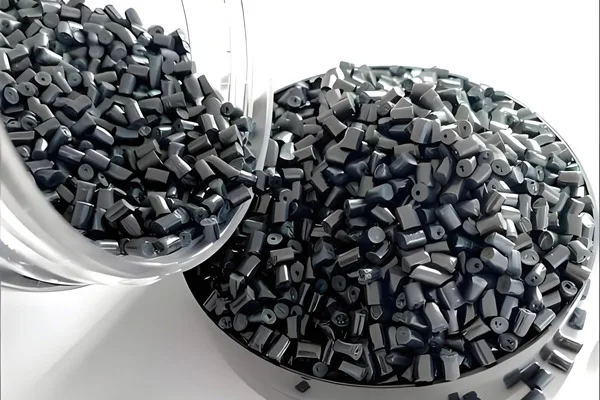
POM particles
Properties of POM
POM is especially well known for its low friction and good sliding properties. Because of this, it is often used in mechanical components that move relative to each other, such as gears, bearings, cams, and sliding mechanisms.
Another important property of POM is its dimensional stability. Unlike Nylon, POM absorbs very little moisture from the environment. This means that POM parts usually maintain their dimensions better when exposed to humidity.
POM also has good fatigue resistance. Parts made from POM can often withstand repeated loading without significant deformation or failure. This makes it suitable for applications where components repeatedly move or flex.
In addition, POM generally has good resistance to oils, fuels, and many organic solvents. This is one reason why it is commonly used in automotive fuel system components or mechanical assemblies.
However, POM does have some weaknesses. For example, it does not perform well when exposed to strong acids or strong oxidizing chemicals. Its resistance to ultraviolet light is also limited unless special stabilizers are added.
Injection Molding of POM
In many cases, POM does not require as strict drying as Nylon. Because it absorbs very little moisture, it can often be processed directly if the material has been stored properly. However, if the material has been exposed to moisture during storage, it may still need some drying.
Processing temperatures for POM are usually lower than for Nylon. Typical processing temperatures may range from about 190°C to 230°C depending on the grade.
One important thing to keep in mind when molding POM is that it can degrade if it is overheated or left in the barrel for too long. Degradation can produce unpleasant odors and gases, so proper temperature control and machine cleaning are important.
POM also has relatively high shrinkage compared with some other plastics. This means that mold design must account for dimensional changes during cooling. Good mold venting is also important to prevent trapped gases.
Comparing Nylon and POM
When comparing Nylon and POM, it is clear that both materials are useful engineering plastics but with somewhat different strengths.
Nylon tends to have better toughness and impact resistance. This means that it can handle shock loads or dynamic stresses more effectively. For example, parts that experience repeated impacts or vibration may perform better when made from Nylon.
POM, on the other hand, tends to have higher stiffness and better dimensional stability. It also has lower friction, which makes it particularly suitable for gears and sliding components.
Another difference is moisture absorption. Nylon absorbs much more moisture than POM. In humid environments, Nylon parts may change dimensions slightly over time. POM parts generally remain more stable in this respect.
Temperature resistance is another consideration. Nylon usually has better heat resistance than POM. This is why Nylon is often used in automotive engine-area components or other applications where higher temperatures may occur.
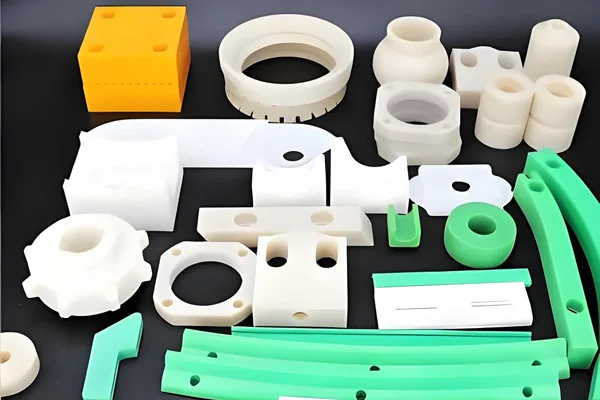
POM products-2
Final Thoughts
Both Nylon and POM are widely used materials in plastic injection molding. Each material has its own strengths and limitations, and the best choice usually depends on the specific requirements of the application.
In general, Nylon may be preferred when toughness, impact resistance, and heat resistance are important. POM may be preferred when dimensional stability, low friction, and precision performance are more important.
Engineers often evaluate several factors before choosing between these two materials. These factors may include mechanical load, environmental conditions, friction requirements, moisture exposure, and production considerations.
Sometimes it also comes down to experience or previous project history. Many engineers simply choose the material that has worked well for similar parts in the past. So while material properties are important, practical experience often plays a role in the final decision as well.