
Moving a product from an early concept to full-scale manufacturing takes more than a promising design. Teams need to test parts, refine materials and processes, and confirm that the product can be produced consistently. Traditional tooling can make this process slow and expensive, especially when a design is still changing.
Rapid tooling offers a practical middle ground. It uses faster, more flexible methods to create molds, dies, fixtures, and other production tools. These tools help manufacturers make prototypes and small batches sooner, while also preparing for larger-scale production.
What Is Rapid Tooling?
Rapid tooling is the accelerated creation of tools used to manufacture parts. Depending on the project, it may involve additive manufacturing, CNC machining, or a combination of processes.
The term commonly covers two approaches:
- Direct rapid tooling: The tool or mold is made directly using a rapid manufacturing process, such as 3D printing or CNC machining.
- Indirect rapid tooling: A master pattern is created first, then used to produce a mold or tool.
Rapid tooling is not a single technology. It is a group of methods that can shorten tooling lead times and make it easier to adjust designs before committing to conventional production tooling.
Why Rapid Tooling Matters
Traditional tooling is often designed for durability, repeatability, and high-volume output. That can make it a strong choice for mature products, but it may require a significant upfront investment and a long development schedule.
Rapid tooling helps teams move forward while a design is still evolving. It can provide:
Shorter development cycles: Tools can often be produced faster than conventional tooling.
Lower initial investment: A team may be able to test a design without immediately paying for a high-volume tool.
Earlier manufacturing feedback: Parts made with production-like processes reveal issues that a digital model or simple prototype may not show.
More design flexibility: Tool modifications can be more manageable during development.
A smoother production transition: Teams can evaluate materials, part geometry, and manufacturing steps before scaling up.
These advantages can be especially useful when a product has a short time to market or when demand is uncertain.
How Rapid Tooling Bridges the Gap
A prototype helps answer questions about shape, fit, and basic function. Production tooling, on the other hand, is built to manufacture parts reliably at scale. Rapid tooling occupies the space between these stages.
It allows teams to make parts using methods and materials that more closely reflect the intended production process. This can help them assess whether a component will perform as expected and whether the manufacturing approach is practical.
For example, a rapid mold can produce a limited run of molded components for assembly testing. A machined fixture can help evaluate a production sequence. A 3D-printed tool insert may be used to test a mold design before investing in a more durable version.
The result is a more informed decision about when—and how—to move into full production.
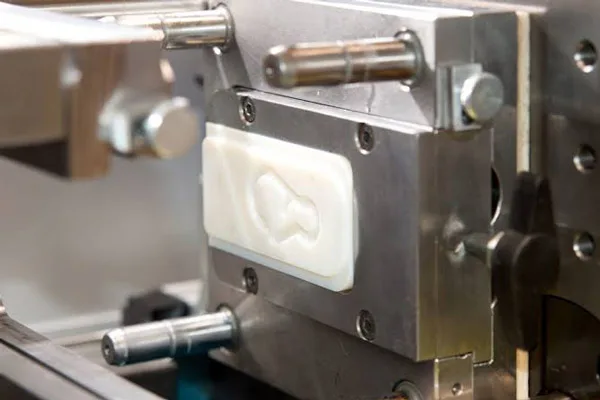
Rapid tooling machine
Common Rapid Tooling Methods
The right method depends on the part, material, required quantity, and testing goals.
3D-Printed Tooling
Additive manufacturing can produce molds, inserts, jigs, and fixtures quickly. It is useful for complex geometries and early-stage testing, though printed tools may have limits in heat resistance, surface finish, or service life.
CNC-Machined Tooling
CNC machining removes material from a solid block to create a tool or mold. It can provide good accuracy and surface quality, and it is compatible with a range of metals and plastics. Machined tooling is often suitable for low-volume production or tools that need greater durability than printed alternatives.
Soft Tooling
Soft tooling is made from relatively inexpensive or less durable materials, such as silicone or certain aluminum alloys. It is often used for prototype runs, bridge production, or products with limited initial demand.
Hybrid Tooling
Some projects combine methods. For instance, a tool base may be CNC-machined while complex inserts are 3D-printed. Hybrid approaches can balance strength, speed, cost, and design freedom.
Benefits for Product Development
Rapid tooling can improve the development process in several ways.
Testing More Than Appearance
A visual prototype can confirm a product’s shape, but it may not reveal how the part behaves under real operating conditions. Rapid tooling can produce functional parts for assembly checks, user trials, performance tests, and limited field evaluations.
Finding Design Problems Earlier
Manufacturing can expose issues such as difficult-to-fill areas, weak sections, excessive warping, or features that are hard to machine. Catching these problems before investing in high-volume tooling can prevent costly redesigns later.
Supporting Design Iteration
Product development rarely follows a straight line. Rapid tooling makes it easier to test adjustments to dimensions, materials, or tool features without restarting a lengthy tooling process each time.
Producing Small Batches
Some products need a limited quantity before full production begins. This may be to support pilot programs, early customer orders, certification testing, or market research. Rapid tooling can make these smaller runs more practical.
Limitations to Consider
Rapid tooling is not always the best option. Its suitability depends on the project’s requirements.
Tool life may be limited. Some rapid tools are not designed to withstand long production runs.
- Part quality may differ from final production. Surface finish, material properties, or dimensional consistency can vary by method.
- Unit costs may be higher for larger quantities. A low-cost tool may not be economical when production volumes increase.
- Process compatibility matters. A prototype tool may not accurately represent the behavior of a production-grade tool.
- Finishing and inspection still take time. Faster tool creation does not eliminate the need for quality checks or post-processing.
It is important to define what the parts need to prove. A tool suited to fit checks may not be suitable for validating long-term durability or final production quality.
Choosing the Right Approach
Before selecting a rapid tooling method, consider:
Part requirements: What dimensions, tolerances, surface finish, and material properties are important?
Production quantity: Is the goal to make a handful of parts, a pilot batch, or a larger bridge run?
Testing purpose: Are you checking fit, appearance, performance, assembly, or manufacturing feasibility?
Expected tool life: How many cycles must the tool withstand?
Future production plan: Will the same process continue, or will the product move to conventional tooling?
Budget and schedule: How do the upfront tooling cost, part cost, and lead time compare?
Discussing these points with a tooling or manufacturing partner can help ensure the process matches the project’s real needs.
How to Make the Transition to Production Smoother
Rapid tooling works best when it is part of a broader manufacturing plan. Keep design files, material specifications, and inspection requirements up to date. Record what is learned during each build, including defects, tool wear, and process settings.
Before scaling up, confirm that the final production process can reproduce the required part quality. This may involve updating the tool design, changing materials, improving cooling or gating, or revising the inspection plan.
Treating rapid tooling as a learning stage—not simply a faster way to make parts—helps teams make better decisions about full-scale production.
Conclusion
Rapid tooling connects early product development with manufacturing by making tools and parts available sooner. It can reduce development delays, support practical testing, and help teams identify production challenges before making a larger investment.
It is not a replacement for every form of conventional tooling. Instead, it is a flexible option for projects that need to move from prototype to production with greater speed and less uncertainty. By choosing the method according to the part, quantity, testing goals, and production plan, businesses can use rapid tooling to make a more confident transition to market.