
In recent years, additive manufacturing has revolutionized the way industries design, prototype, and produce components. Among the myriad of materials available, Thermoplastic Polyurethane (TPU) has emerged as a popular choice for creating flexible, durable, and high-performance industrial parts through 3D printing. This guide aims to provide an in-depth overview of TPU 3D printing, focusing on its applications, benefits, and best practices for industrial use.
The rapid adoption of TPU is not accidental. As industries push for lighter, more resilient, and customisable components, TPU offers a unique combination of rubber-like elasticity with the processing advantages of thermoplastics. Unlike silicone or traditional rubber, TPU can be melted, extruded, and re-melted, making it perfectly compatible with fused filament fabrication (FFF) and powder-bed technologies such as selective laser sintering (SLS). This versatility has positioned TPU as a go-to material for prototyping and end-use production across the automotive, medical, robotics and consumer goods sectors.
What is TPU?
Thermoplastic Polyurethane (TPU) is a versatile elastomeric material known for its excellent elasticity, abrasion resistance, chemical stability, and durability. Its unique properties enable it to stretch significantly without breaking and recover its shape quickly, making it ideal for applications that require flexible and resilient parts.
Why Use TPU in Industrial 3D Printing?
The adoption of TPU in industrial settings is driven by its ability to produce parts that combine flexibility with strength. This material is well-suited for applications such as:
Flexible seals and gaskets: Providing airtight and watertight seals in machinery.
Protective covers and cases: Absorbing shocks and impacts to protect sensitive equipment.
Custom flexible components: Such as hoses, grips, and wearable devices.
Vibration dampers: Reducing noise and vibration in machinery.
Prototyping of flexible parts: Allowing engineers to test designs before mass production.
Beyond these common uses, TPU is increasingly found in more demanding industrial scenarios. For instance, in automated assembly lines, TPU grippers and suction cups enable gentle handling of delicate or irregularly shaped objects without leaving marks. In the aerospace sector, TPU is used for lightweight ducting, anti‑vibration mounts, and even non‑pneumatic tyre prototypes. The medical industry relies on biocompatible TPU for custom orthoses, prosthetics liners, and flexible tubing. Additionally, the rise of soft robotics has opened new frontiers – TPU actuators and sensors can mimic biological movements, enabling safer human‑robot interactions. The material’s ability to be printed with complex internal lattice structures further expands its utility, allowing designers to create parts with tailored stiffness gradients, energy‑absorbing cores, and conformal cooling channels.
Benefits of Using TPU for 3D Printing
Flexibility and Elasticity: TPU parts can bend and stretch without cracking, mimicking rubber-like properties.
Durability and Wear Resistance: Excellent resistance to abrasion, tears, and impact.
Chemical Resistance: Resistant to oils, greases, and various chemicals.
Lightweight: Produces parts that are both strong and lightweight.
Ease of Post-Processing: Can be cut, drilled, or glued after printing.
TPU vs. Rubber: Pros and Cons
When benchmarked against silicone rubber, TPU offers superior tensile strength and tear resistance, as well as the ability to be processed without vulcanisation or mold tooling. However, silicone retains better long-term compression set resistance and stable performance above 100°C, whereas TPU typically softens beyond 80°C. Compared to standard TPE blends, TPU provides higher abrasion resistance—often three times greater—and better resistance to aliphatic hydrocarbons. The trade-off is that TPU is less forgiving in printing, demanding stricter drying and more conservative speed settings. Industrial users should also note that while TPU is highly durable, its UV resistance is moderate; for outdoor applications, carbon-black filled or specially stabilised grades are recommended. Understanding these trade-offs ensures that TPU is deployed where its strengths are maximised and its weaknesses are mitigated through design or material selection.
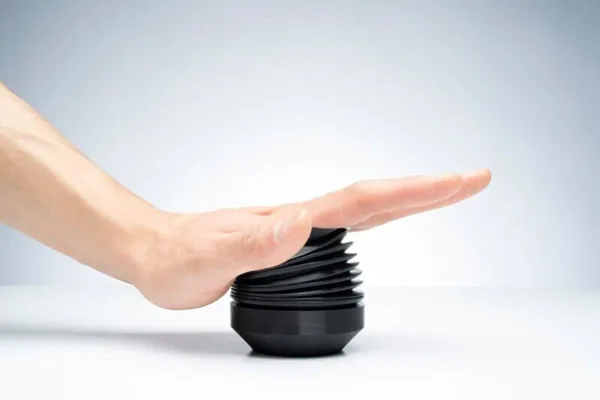
Flexibilty TPU part
Selecting the Right TPU Filament
Choosing the appropriate TPU filament is critical for achieving optimal results. Consider factors such as:
Tensile Strength: For parts subjected to high stress.
Elongation at Break: To ensure flexibility.
Hardness (Shore A): Ranging from soft (80A) to firm (95A), depending on application needs.
Color and Transparency: For aesthetic or functional purposes.
Brand Reputation and Quality: Ensuring consistent performance.
3D Printing TPU: Best Practices and Tips
1. Use a Direct Drive Extruder: TPU is flexible and can jam in Bowden extruders; a direct drive setup provides better control.
2. Optimal Print Settings:
- Nozzle Temperature: Typically between 210°C and 240°C.
- Bed Temperature: Around 40°C to 60°C.
- Print Speed: Slower speeds (20-30 mm/s) help achieve better layer adhesion.
- Retraction Settings: Minimize retraction distance to prevent filament jams.
3. Print Bed Preparation: Use a flexible build plate or surfaces like PEI to improve adhesion.
4. Layer Height: Use finer layers for detailed or precise parts.
5. Cooling: Moderate cooling to prevent warping while maintaining layer adhesion.
6. Design Considerations: Incorporate chamfers or fillets to reduce stress concentration points.
Challenges and Troubleshooting
Stringing and Oozing: Adjust retraction and temperature settings.
Warping: Ensure proper bed adhesion and use enclosed printers if possible.
Difficulty in Extrusion: Check filament quality and ensure the extruder is clean and properly calibrated.
Layer Adhesion Issues: Optimize printing temperature and speed.
Post-Processing of TPU Parts
Post-processing steps can enhance the functionality and appearance of TPU parts:
- Trimming and Finishing: Remove excess material or support structures.
- Gluing: Use compatible adhesives for assembly.
- Surface Treatment: Sanding or coating for improved surface finish or additional properties.
- Testing: Conduct mechanical and environmental tests to validate performance.
Future Trends in TPU 3D Printing for Industry
As 3D printing technology advances, TPU materials are expected to become even more specialized, offering tailored properties such as enhanced chemical resistance or improved environmental stability. Integration with multi-material printers will enable complex, flexible assemblies combining TPU with rigid materials, opening new horizons in industrial design and manufacturing.
Conclusion
TPU 3D printing offers a powerful tool for industries seeking to produce flexible, durable, and functional parts with rapid turnaround times. Understanding the material properties, optimal printing practices, and application-specific considerations is essential for harnessing the full potential of TPU in industrial contexts. As technology continues to evolve, TPU’s role in additive manufacturing is poised to expand, enabling innovative solutions across various sectors.