
In the competitive landscape of manufacturing, speed, efficiency, and cost-effectiveness are crucial factors that drive innovation and profitability. Rapid injection molding has emerged as a revolutionary technique that enables companies to produce high-quality plastic components quickly and affordably. This article offers an in-depth exploration of rapid injection molding, covering its definition, the equipment involved, key benefits, and distinctive features that set it apart from traditional manufacturing methods.
What Is Rapid Injection Molding?
Rapid injection molding is an advanced manufacturing process designed to produce plastic parts in a shorter time frame compared to conventional injection molding. It combines rapid prototyping techniques with traditional injection molding to develop functional, high-quality prototypes or small production runs rapidly and cost-effectively.
Unlike traditional injection molding, which can take several weeks to months for tooling and production, rapid injection molding leverages specially designed tools and materials to significantly reduce lead times, sometimes to just a few days. This approach allows product designers and manufacturers to validate designs, perform testing, and make iterative improvements before committing to mass production.
Key distinctions:
- Speed: Significantly faster turnaround times.
- Cost: Lower tooling costs, especially for small batches.
- Flexibility: Easier to modify designs during development.
The Step-by-Step Rapid Injection Molding Workflow
1. CAD Design & DFM Analysis: The part is designed in 3D CAD software. A Design for Manufacturability (DFM) review is conducted immediately to identify potential issues like sharp corners, uneven wall thickness, or inadequate draft angles that could complicate rapid tooling.
2. Mold Design & Simulation: Engineers design the mold core and cavity, often using mold-flow simulation software to predict fill patterns, air traps, and weld lines. This digital step reduces physical trial-and-error.
3. Rapid Tooling Fabrication: Instead of milling hardened steel, the mold is CNC-machined from aluminum or 3D-printed using high-strength resins. This step takes 1–2 weeks, compared to 4–8 weeks for traditional steel.
4. Mold Fitting & Polishing: The mold halves are fitted, polished, and mounted onto the injection molding machine. Ejector pins and cooling lines are verified.
5. First-Article Inspection (FAI): The first shots are run, dimensions are measured against the CAD model, and adjustments are made to injection pressure, temperature, and cooling time to optimize part quality.
6. Iterative Production: Because modifications take hours rather than weeks, design changes are implemented on the fly, allowing multiple design iterations within the same development sprint.
Equipment Used in Rapid Injection Molding
The equipment involved in rapid injection molding is tailored for speed, flexibility, and cost savings. Some of the defining features include:
Rapid Tooling Machines
These are specialized injection molding machines compatible with quick-to-fabricate molds. They often utilize lightweight, durable materials such as aluminum or composite composites instead of traditional steel, enabling rapid manufacturing of tooling.
Quick-Change Mold Systems
Modular mold systems that can be rapidly swapped or adjusted facilitate quick iterations during product development phases.
CNC Machining and 3D Printing Equipment
These technologies are frequently used to produce prototype molds or master patterns swiftly, which are then used to create the final molds.
Injection Molders with High-Temperature Capabilities
Rapid molding machines are equipped to handle a variety of thermoplastics, allowing for a broad range of material options.
How Does the Equipment Contribute?
The key to rapid injection molding’s efficiency lies in the use of lightweight, low-cost molds and the ability to quickly modify or replace them. This flexibility allows for fast iterations, testing, and validation without the lengthy lead times associated with traditional steel molds.
Key Design for Manufacturability (DFM) Tips for Rapid Molding
Even with rapid tooling, poor design can negate the speed benefits. To maximize success in rapid injection molding, designers should adhere to these specialized DFM guidelines:
- Uniform Wall Thickness: Maintain consistent wall thickness to prevent sink marks, voids, and warpage. Thick sections cool slower, causing internal stresses.
- Generous Draft Angles: Incorporate at least 1° to 2° of draft per side. This allows the part to release easily from the aluminum mold, reducing wear on the softer tooling.
- Adequate Radii at Corners: Sharp inside corners act as stress concentrators and impede material flow. A radius of at least 0.020″ to 0.030″ is recommended to improve fill and extend tool life.
- Strategic Gate Placement: Position the gate at the thickest section of the part to ensure uniform packing and minimize flow-induced stress.
- Avoid Undercuts Where Possible: While side-actions and lifters are possible, they add complexity and cost to the rapid tool. Design parts to pull straight from the mold to maintain speed and simplicity.
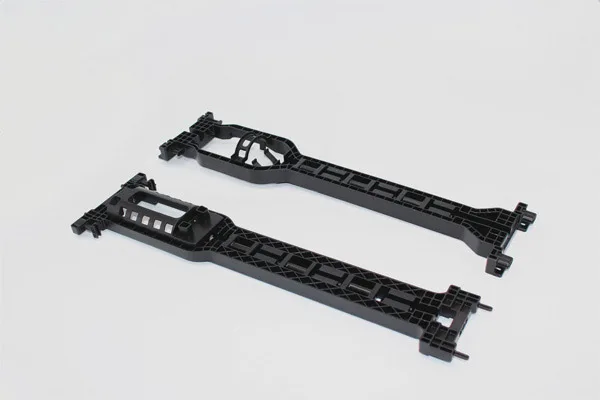
Airplane parts
Advantages of Rapid Injection Molding
Rapid injection molding offers numerous benefits that make it an attractive choice for product development and small-batch production:
Fast Turnaround Times
From design to finished part, the entire process can be completed in days or weeks, enabling rapid prototyping and quick testing cycles.
Cost-Effective for Small Batches
Traditional steel molds are expensive and economical only for large production runs. Rapid tooling reduces upfront costs, making small runs financially viable.
Design Flexibility and Iteration
Designers can easily modify mold components or part designs during development, facilitating iterative testing and refinement.
Functional Prototypes
Parts produced via rapid injection molding can be used for functional testing, marketing, or user validation, providing a true-to-production experience.
Reduced Risk
Early testing and validation help identify design flaws or manufacturing issues before mass production, reducing the risk of costly recalls or redesigns.
Material Variety
A broad range of thermoplastics and some thermosets can be used, allowing for versatile application options.
Characteristics of Rapid Injection Molding
While similar to traditional injection molding in process fundamentals, rapid injection molding has several distinctive characteristics:
- Lightweight, Aluminum Molds: Unlike steel molds, these are easier and quicker to produce, but may have a shorter lifespan suitable for small batches.
- Modular and Flexible Mold Design: Allows for quick modifications and adjustments during development.
- Short Lead Times: Typically, mold fabrication can be achieved within days to a few weeks.
- Limited Production Volume: Best suited for small to medium batches—generally up to a few thousand parts.
- Material Compatibility: Primarily thermoplastics like ABS, polycarbonate, and polypropylene; some high-performance materials are also possible.
Limitations
Despite its advantages, rapid injection molding does have limitations:
- Mold Durability: Aluminum molds wear out faster than steel, limiting the number of parts produced.
- Part Size and Complexity: Larger or highly intricate parts may not be suitable.
- Material Restrictions: Not all plastics are compatible with rapid tooling processes.
- Surface Finish: The surface quality may not match that of steel molds used in high-volume production.
Applications of Rapid Injection Molding
Product Development and Testing: Creating prototypes that closely resemble final parts for testing and validation.
Design Verification: Validating fit, form, and function before mass production.
Small Batch Manufacturing: Producing limited quantities for niche markets, specialized applications, or initial product launches.
Marketing and Demonstration Models: Producing realistic models for presentations or trade shows.
Functional Samples for Testing: Develop samples for performance testing, durability assessments, and regulatory compliance.
Customization and Personalization: Easily modify designs for customized versions or small series without extensive retooling.
Medical and Consumer Electronics: Rapidly prototype complex, high-precision components for evaluation and iteration.
Educational and Training Models: Produce detailed models for educational purposes, training, or demonstration in technical fields.
Research and Innovation: Support R&D efforts by enabling quick iterations and testing of new concepts.
Conclusion
Rapid injection molding is a game-changing manufacturing technology that bridges the gap between prototyping and mass production. By combining quick tooling methods with traditional injection molding processes, it offers a fast, flexible, and cost-effective solution for producing functional plastic parts in small to medium quantities.
Its ability to accelerate product development cycles, reduce costs, and facilitate design iteration makes it an indispensable tool for startups, designers, and established manufacturers alike. As technology advances, rapid injection molding is poised to become even more versatile, enabling faster innovation and bringing new products to market with unprecedented speed.
If you are looking to shorten your development timeline, reduce initial investment risks, or produce small batches of high-quality parts, rapid injection molding deserves serious consideration as your manufacturing solution.