
Motorcycle lighting was no longer merely a functional requirement; It is the defining element of a bike’s identity. From sleek LED headlamps with sophisticated beam patterns to stylish tail lights that integrate stop, turn and position signals into a single, seamless unit, the demands on modern motorcycle lighting components have never been higher. At the heart of this evolution lies plastic injection molding – a manufacturing process that, when executed with precision, delivers optical clarity, structural durability and unprecedented design freedom.
This article explores the sophisticated world of injection molding for motorcycle lamps, focusing on the technologies that enable high precision and multi‑color efficiency, and how they collectively shape the quality, safety, and aesthetics of the final product.
The Importance of Precision in Motorcycle Lighting
Motorcycle lighting components, such as headlights, taillights, turn signals, and accent lights, demand exceptional precision. These components must fit perfectly within the motorcycle’s design, ensuring seamless integration and optimal performance. Plastic injection molding offers unparalleled accuracy in producing complex shapes with tight tolerances, ensuring that each part meets exact specifications.
Moreover, the precision of injection molding allows for intricate detailing, such as textured surfaces, embossed logos, or specialized lens designs. This level of detail not only enhances the aesthetic appeal but also contributes to the functional aspects of lighting, such as light diffusion and focus.
Materials: Matching Performance to Application
Choosing the right plastic is the first step toward a successful lighting component.
Polycarbonate (PC)
- Use – Headlamp lenses, outer tail light covers, and transparent components requiring high impact resistance.
- Why – PC offers exceptional toughness, thermal stability (up to ~130°C), and good optical clarity. It can be coated with hard coats or anti‑fog layers to improve scratch resistance.
Polymethyl Methacrylate (PMMA / Acrylic)
- Use – Clear lenses where scratch resistance and weatherability are prioritized over extreme impact strength.
- Why – PMMA has superior UV stability and surface hardness compared to PC, making it ideal for exposed lenses that must remain clear for years.
ABS and ASA
- Use – Lamp housings, bezels, and internal structural parts.
- Why – ABS provides a balance of strength, stiffness, and cost; ASA offers improved weatherability for exterior black components.
Polypropylene (PP) with Talc Fillers
- Use – Housings where weight reduction and chemical resistance are key.
- Why – Glass‑ or talc‑filled PP is lightweight and resistant to many automotive fluids, though it requires careful design to match.
Multi‑Color Injection Molding: Efficiency Through Integration
One of the most transformative advancements in motorcycle lighting manufacturing is multi‑component injection molding. Traditionally, a multi‑color tail light—say, a red stop lens with a clear turn signal segment—required molding two separate parts and then assembling them via vibration welding, ultrasonic welding, or adhesive. This added labor, increased the risk of leaks, and created visible seams.
Multi‑shot molding eliminates these drawbacks.
How It Works
Multi‑shot molding is performed on specialized injection molding machines with two or more injection units. The process typically follows one of two approaches:
- Rotary platen – The mold has two cavities. The first shot is injected. The mold opens, and the platen rotates 180°. The second shot is injected over the first, bonding chemically.
- Core‑back / retractable core – The mold’s core retracts after the first shot, creating new cavities for the second shot without moving the part.
Benefits
- Seamless bonding – The materials fuse at the molecular level, creating a monolithic part with no mechanical weak points.
- Superior water tightness – Without assembly seams, the risk of moisture ingress is virtually eliminated.
- Enhanced aesthetics – Precise, sharp boundaries between colors improve the visual appeal and meet strict regulatory requirements for light emission zones.
- Reduced assembly – Fewer production steps translate to lower labor costs and faster throughput.
Design Considerations
Successful multi‑shot molding requires careful attention to:
- Material compatibility – The two materials must bond without delamination. PC‑to‑PC is common; PC‑to‑PMMA requires specific tie layers.
- Shrinkage balance – Differential shrinkage between the two materials can cause warpage; mold flow simulation helps predict and mitigate this.
- Gate placement – Gates for the second shot must be positioned to avoid washing away or disturbing the first shot.
Simulation and Process Optimization
Before a mold is built, mold flow analysis (CAE) is performed to simulate the injection process. This virtual environment allows engineers to:
- Optimize gate locations to minimize weld lines and ensure uniform filling.
- Predict air traps and venting requirements.
- Analyze cooling efficiency and identify areas prone to warpage.
- Determine the ideal injection speed, pressure, and temperature profiles.
- Evaluate the multi‑shot process, ensuring that the second shot does not deform the first.
By addressing potential issues digitally, manufacturers reduce costly mold trials, shorten time‑to‑market, and achieve higher first‑time quality.
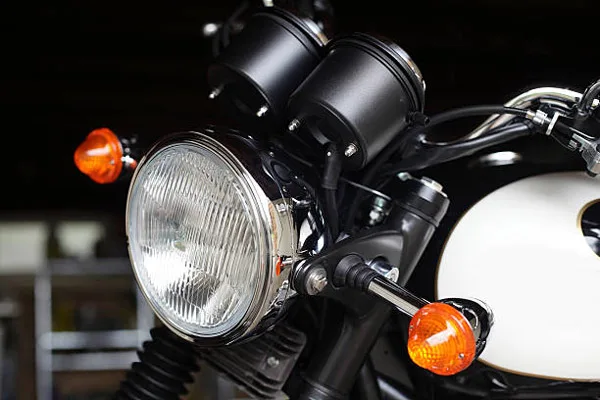
Motorcycle lights
Automation and Industry 4.0
Modern injection molding cells for motorcycle lighting are highly automated. Typical automation features include:
- Robotic part handling – Robots remove parts from the mold, place them on cooling fixtures, and transfer them to downstream operations such as hard coating, metallization, or packaging.
- Insert loading – For housings that require metal threaded inserts or electrical contacts, robots place these inserts into the mold with precision before each cycle.
- Inline vision inspection – High‑resolution cameras inspect lenses for scratches, contamination, color accuracy, and dimensional integrity immediately after molding. Defective parts are automatically rejected.
- Real‑time process monitoring – Sensors embedded in the mold monitor cavity pressure, temperature, and viscosity. Closed‑loop control systems adjust parameters on the fly to maintain consistent part quality.
- The integration of Industry 4.0 principles—data collection, predictive maintenance, and digital twins—further enhances efficiency and reduces unplanned downtime.
Quality Assurance and Testing
Every injection‑molded lighting component must undergo rigorous testing to comply with global standards. Key tests include:
- Optical performance – Measurement of luminous intensity, beam pattern, and color coordinates (chromaticity) using goniometers and spectrophotometers.
- Environmental simulation – Thermal cycling (e.g., -40°C to +85°C), UV exposure, humidity, and salt spray testing to ensure long‑term durability.
- Leak testing – Multi‑color tail light assemblies are subjected to air or helium leak tests to verify water tightness.
- Vibration and shock – Simulated road vibrations ensure that all joints, snap‑fits, and bonded interfaces remain intact.
Future Trends in Motorcycle Lighting Molding
As motorcycle lighting technology advances, injection molding processes must adapt. Several trends are shaping the future:
Light Integration and Surface Structuring
Instead of using separate lenses and reflectors, manufacturers are increasingly molding light‑guiding microstructures directly into the lens surface. This is achieved through high‑precision mold texturing (using laser‑etched or diamond‑cut inserts) that creates prismatic or diffractive patterns. The result is uniform light distribution with fewer components.
Lightweighting
With the rise of electric motorcycles, weight reduction is paramount. Structural foam molding and the use of glass‑fiber‑reinforced thermoplastics allow housings to be thinner and lighter while maintaining strength.
Digital Twin and Smart Molding
Full digital twins of the entire production cell—mold, machine, and auxiliary equipment—enable virtual commissioning and optimization. Machine learning algorithms can predict quality deviations before they occur, enabling proactive adjustments.
Sustainable Manufacturing
Recycling and bio‑based polymers are gaining traction. Manufacturers are exploring the use of post‑consumer recycled (PCR) materials for non‑optical components, as well as energy‑efficient molding processes that reduce carbon footprint.
Conclusion
Plastic injection molding for motorcycle lighting has evolved far beyond simple part production. It now encompasses precision mold engineering, multi‑color integration, advanced simulation, and fully automated manufacturing cells. These technologies work in concert to deliver components that not only meet stringent safety and durability standards, but also elevate the aesthetic and functional appeal of modern motorcycles.
From the clarity of a polycarbonate headlamp lens to the seamless integration of a multi‑color tail light, injection molding remains the enabling technology that turns complex designs into reliable, high‑quality products. As lighting systems become smarter – with adaptive beam patterns, dynamic turn signals and integrated sensors – the injection molding industry will continue to innovate to ensure that the motorcycle lighting of tomorrow is safer, more efficient and more expressive than ever before.