
Compression molding is a highly versatile and efficient manufacturing process widely used in industries such as aerospace, automotive, electronics and consumer goods. It involves placing a pre-measured amount of a material – often a thermoset resin, thermoplastics, or composites – into a heated mold cavity. The mold is then closed under pressure, causing the material to conform to the shape of the cavity, curing or cooling to form the finished part. While compression molding offers numerous benefits, including excellent surface finish and good dimensional stability, optimizing the process is essential to maximize efficiency, quality and cost-effectiveness.
Understand Your Material Properties
Material selection and understanding are fundamental to process optimization. Different materials – such as thermosets, thermoplastics, or composites – have unique behaviors with respect to flow, curing, and temperature sensitivity.
- Perform thorough material characterization: understand flow properties, curing times, shrinkage rates, and thermal properties.
- Use compatible materials: Ensure that the chosen resin or composite is suitable for compression molding, taking into account viscosity, curing temperature, and mechanical properties.
- Optimizing material handling: Store and handle materials properly to prevent contamination or degradation, which can affect quality.
Precise Mold Design and Maintenance
A well-designed mold is critical to achieving consistent, high-quality parts.
Design for uniform material flow: Incorporate proper venting, gating, and runner systems to promote even filling and minimize air entrapment.
Ensure proper mold temperature control: Use heating and cooling channels effectively to maintain uniform temperature distribution, reducing warping and shrinkage.
Regular maintenance: Keep molds clean and free of defects. Regular inspection for wear and damage ensures consistent part quality and reduces cycle times.
Optimize Process Parameters
Fine-tuning process parameters can significantly impact cycle time, part quality, and production costs.
- Temperature settings: Set mold and material temperatures based on material specifications. Too high or too low temperatures can lead to incomplete curing or material degradation.
- Pressure control: Apply appropriate pressure levels to ensure complete filling and proper compaction without damaging the mold or causing defects.
- Cycle time management: Balance heating, pressing, curing, and cooling times to maximize throughput while maintaining quality.
- Preheating and preforming: Preheating materials or preforming components can improve flow and reduce cycle times.
Implement Process Monitoring and Control
Real-time monitoring helps detect issues early and ensures process consistency.
Use sensors and gauges: Incorporate temperature, pressure, and force sensors to monitor process variables continuously.
Data collection and analysis: Use data analytics to identify trends, optimize parameters, and predict maintenance needs.
Automate controls: Employ programmable logic controllers (PLCs) and advanced control systems for precise adjustments and reproducibility.
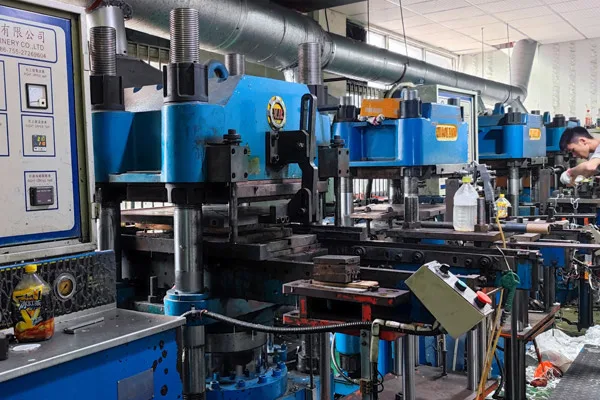
Compression molding machines
Conduct Regular Quality Checks
Consistent quality inspection ensures that the process remains optimized and defects are minimized.
- Visual inspection: Check for surface defects, warping, or incomplete fills.
- Dimensional measurement: Use gauging tools or coordinate measuring machines (CMM) to verify part dimensions.
- Mechanical testing: Conduct strength, hardness, or other relevant tests to confirm material properties meet specifications.
- Implement feedback loops: Use inspection results to adjust process parameters proactively.
Invest in Training and Skilled Workforce
An educated and skilled team is essential for successful process optimization.
Regular training: Keep operators informed of best practices, safety procedures, and new technologies.
Encourage collaboration: Promote communication between design, engineering and production teams to quickly identify and resolve process issues.
Empowering operators: Enable frontline staff to make adjustments based on real-time observations within established guidelines.
Embrace Technological Advancements
Leverage modern technologies to enhance process efficiency.
- Simulation software: Use mold flow analysis to predict material behavior and optimize mold design before production.
- Additive manufacturing: Create prototypes or complex mold features quickly and cost-effectively.
- Advanced materials: Explore new composite materials that offer better flow, curing, or mechanical properties.
- Automation and robotics: Incorporate automation for material handling, mold closing, and part removal to increase consistency and reduce labor costs.
Conclusion: A Systematic Approach to Excellence
Optimizing compression shaping is not a one-time event, but a continuous cycle of monitoring, analysis, and adjustment. It requires a holistic view that connects materials science, tooling, process engineering and quality management. By systematically addressing each stage – from material preparation and mold design to parameter control and data analysis – you can transform your compression molding process into a model of efficiency and reliability. The result is robust, cost-effective production of high-performance components that meet the most stringent specifications.